

Rethinking Beginner, Intermediate, & Advanced Yoga
Maybe we need to use better labels

I was visiting another yoga teacher trainer who lived out of state so we could work on a project together. One morning he suggested that we go take a class. He had a friend who kept inviting him to her class, but he hadn’t yet taken her up on it, so my visit was a good excuse to finally check it out.
When we got to the studio, we slipped into the back of the room. He didn’t introduce me because the class was about to start. The teacher was friendly, young and flexible. As the class progressed, I found ways to explore her sequence that worked for my body.
But several times during the class she approach me and said, “This is how to do that if you’re a beginner.” Other times she said to me, “You can skip this pose if you’re a beginner” or “Advanced students can do the pose this way, but you should use a strap if you’re a beginner.”
But at that point I’d been practicing yoga regularly for more than 15 years and teaching for more than 10 – and not just classes, but workshops and teacher trainings – I’d written manuals and published articles. But she didn’t know me. So she assumed I was a beginner – because I’m not hypermobile.
After class when my friend introduced me to her as a yoga teacher trainer, she was noticeably taken aback. I thanked her and we chatted for a little while and then said our goodbyes. It was a little awkward, and it left me wondering: Why had she been taught (or unconsciously internalized) that people with less flexibility are automatically beginners?
In the 90s and 2000s, it was fairly ubiquitous to label classes “Beginner”, “Intermediate”, and “Advanced”, or “Level 1”, “Level 2”, and “Level 3.” It was equally common for students and teachers to believe that you start with beginner or level 1 classes, and then, within a few weeks or month you progress to intermediate/level 2, and after a year or two, to advanced/level 3.
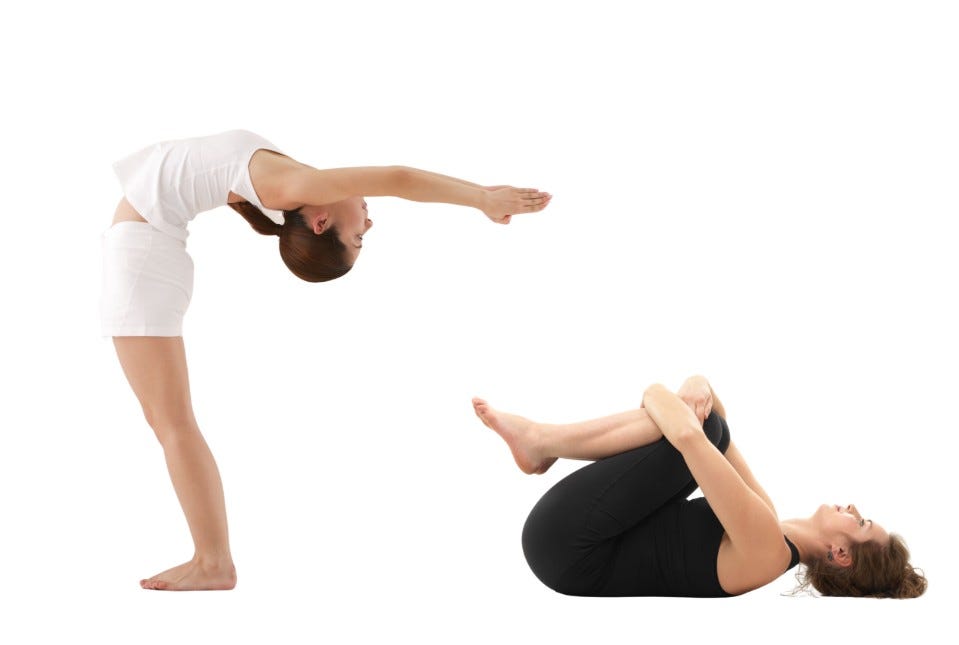
One time I was in a class and the teacher said, “Just keep doing this and you will eventually become advanced.” That’s patently untrue – she was hypermobile.
Labeling classes and poses as “Beginner”, “Intermediate”, and “Advanced” is problematic for several reasons.
First, it reduces yoga to asanas, and it reduces progress in yoga to the accomplishment of difficult asanas. But yoga has 8 limbs, asanas are 12.5 percent of the system – there’s another 87.5 percent to explore.
Secondly, since when does being hypermobile automatically make you an advanced yoga practitioner? With that logic, just about everyone in Cirque du Soleil should be enlightened by now.
Third, this kind of labeling engenders poor teaching. Working only with those with a lot of mobility means you don’t have to learn how to teach to the more typical-bodied person. You can simply call out pose names.
Classes exclusively full of hypermobile students is becoming rarer and rarer – typically there are lots of people in the room with a wide range of mobility and strength.
For many years I was labeled a “beginner” teacher because, as someone who was not hypermobile and didn’t teach many hardcore poses, it made sense in terms of the beginner-intermediate-advanced paradigm. I love working with many different kinds of people with different kinds of bodies, but it feels uncomfortable to impose a label on my students – many of whom have been practicing yoga for years.
There are plenty of long-time practitioners who want to attend a variety of yoga classes – but if the only class that fits their needs or wants is titled “beginners” is that an appropriate term for those students? Even when they’ve been practicing for longer than the teacher?
While anachronistic class titles are beginning to fall away, we still have work to do in developing better ones – and better descriptions. Perhaps some “Advanced” classes might be better described as:
“Difficult Yoga Posture Class – to safely enjoy this class, you should be able to do postures, including one leg balances, with binds (arms threaded through one leg and then wrapped around your back and hands clasped), deep lunges, and arm balances in the middle of the room without assistance. Be prepared to move quickly and sweat. If you have injuries or limited mobility you will be expected to take care of yourself because the class moves too fast for the instructor to be able to assist everyone.”
I think being clear is a good start. And if there’s concern that people won’t show up because they’re scared off by that description…well…that’s food for thought, isn’t it?
If the class consists primarily of sun salutes and their derivations, then there should be some care around using titles like “Yoga for Everybody” or “Flow for Everyone” or “Mindful Flow” etc. – These classes may not be appropriate for folks with more moderate mobility.
I think it’s time to craft alternative class labels and descriptions that go beyond beginner, gentle, Yin, and restorative, and get more creative (and accurate) about how we talk about what we teach.
On Saturday, we’ll be announcing our upcoming Subtle Yoga 300 Hour Advanced Teacher Training program. Sign up for our newsletter to find out more: https://subtleyoga.com/contact/
Thank you for the insightful article.
As a longtime yoga teacher I have experienced and taught many styles and have witnessed firsthand the pigeonholing language that frequents the yoga world. Also having been a business owner of 3 studios am very aware how the “yoga language” often reflects their competitive business model.
I have been teaching mindfulness based, functional fitness yoga for the last 16 years with the premise that no one can fail at yoga. There is no pass or fail, no perfection, no finishing point; all there ever is, is practice. I use simple language in guiding participants to understand A: how their body can express a given posture and B: how much they can lean into the challenges they encounter in their body without crossing the line into pain yet also embracing a “productive level of discomfort” that they instinctively hear their body saying yes to.
This has everything to do with mindfulness and nothing to do with ego which either comes from within or from teaching prompts. I like to think of this as meditation with movement.
Kindly,
Henri Ferguson 🙏
I am a yoga teacher of nearly 20 years and very much agree. A pet peeve is when classes labeled all level or beginner/ beginner friendly flow through sun salutations without instruction, and people with limited strength and mobility get injured. It is hard to get students to leave their egos at the door and listen to their bodies without playing the comparison game -- that as much as the poses is a skill that often develops over time, so as teachers we need to do our best to protect those still cultivating awareness.